Leveraged osETH/WETH Looping Strategy on Gearbox

osETH isn't just a liquid staking token—it's a composable DeFi building block. While holding osETH earns you Ethereum staking rewards passively, its real power emerges when plugged into the broader DeFi ecosystem.
In January 2026, a new osETH strategy, created by Gearbox in collaboration with kpk (formerly karpatkey), went live: a leveraged looping position that stacks multiple yield sources on top of your osETH—potentially reaching up to ~34% APY depending on your chosen leverage.
This guide breaks down exactly how this strategy works under the hood and how you can access it.
What is Gearbox Protocol?
Gearbox is permissionless lending protocol that enables borrowers to take leveraged positions across whitelisted collateral in a simple way.
The core primitive is the Credit Account: a smart contract wallet that holds your position (collateral + debt + LP tokens). Each Credit Account is isolated and operates within the risk environment defined by Market Curators like kpk, who set liquidation thresholds, collateral quota limits, utilisation caps, oracle choices, and adapter allowlists.
This architecture enables something powerful: you can borrow assets and deploy them into complex DeFi strategies in a single atomic transaction (borrow → swap → LP → stake → loop).
Built on Gearbox and curated by kpk, the new osETH strategy allows a leveraged looping that combines Ethereum staking native yield from osETH with liquidity provision yields (Balancer), boosted farming (Aura), auto-compounding (Beefy), and Gearbox leverage.
Let’s have a look at how it works.
Strategy at a Glance
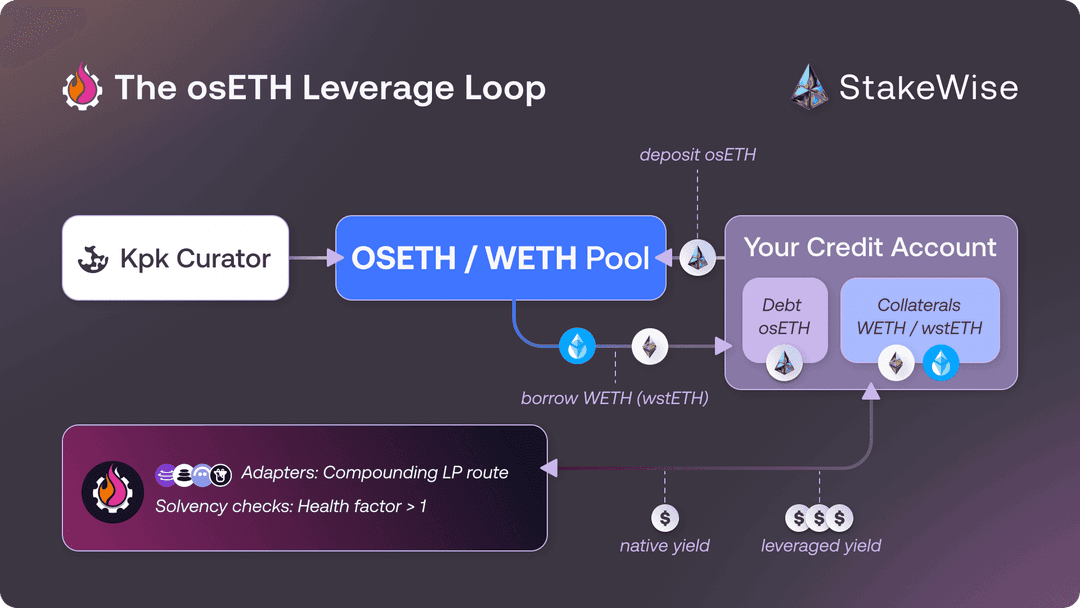
Gearbox executes a single bundled transaction (via multicall + adapters):
Your osETH deposit
Borrows WETH or wstETH at your chosen leverage
Swaps/routes borrowed funds as needed to achieve a balanced position (e.g., convert part to ETH → wrap/mint more osETH if required for 50/50 ratio)
Provides liquidity to the Balancer Boosted osETH/WETH pool. For a deep dive into how this pool works, see our guide.
Stakes the resulting Balancer LP tokens into the corresponding Aura gauge
Deposits that Aura position into the Beefy auto-compounding vault (the “wmooBalancerEthereumosETH-WETH” wrapper)
Sets the Beefy vault token as collateral in the Credit Account
Repeats steps 2-7 up to 10 times (looping), multiplying your exposure with each iteration
The strategy allows you to earn the difference between:
Boosted osETH-ETH pool on Balancer (~5-6% APY)
ETH or wstETH borrow cost (~3% APY)
for up to 10 loops, with just a few clicks!
Juicy Yield
This strategy layers multiple yield sources, each compounding on the previous:
Balancer osETH/WETH Boosted Pool APY. This V3 pool deposits idle liquidity into Aave for additional yield, generating swap fees plus passive lending yield on your LP position.
Aura Finance amplifies your Balancer rewards. Normally, maximizing BAL rewards requires locking BAL tokens for a year. Aura holds a massive amount of locked BAL (veBAL) and shares this boost with all depositors—you get up to 2.5x more BAL rewards plus additional AURA token incentives, without locking anything yourself.
Beefy Finance auto-compounds everything, reducing manual overhead. It harvests your BAL and AURA rewards, sells them, and reinvests into more LP tokens automatically. This creates a compounding osETH LP position usable directly as collateral. Yield accrues inside the position, supporting cleaner loop dynamics.
This entire yield stack operates within kpk's curated risk environment. As with all kpk-curated strategies on Gearbox, assets are isolated in dedicated credit managers with conservative quotas, carefully calibrated liquidation thresholds, and independent price feeds—all under continuous monitoring. The goal: expand strategy options with explicit, predictable risk—not increase systemic exposure.
📘More on kpk’s curation and risk framework: https://docs.kpk.io/vaults
Step-by-Step Guide
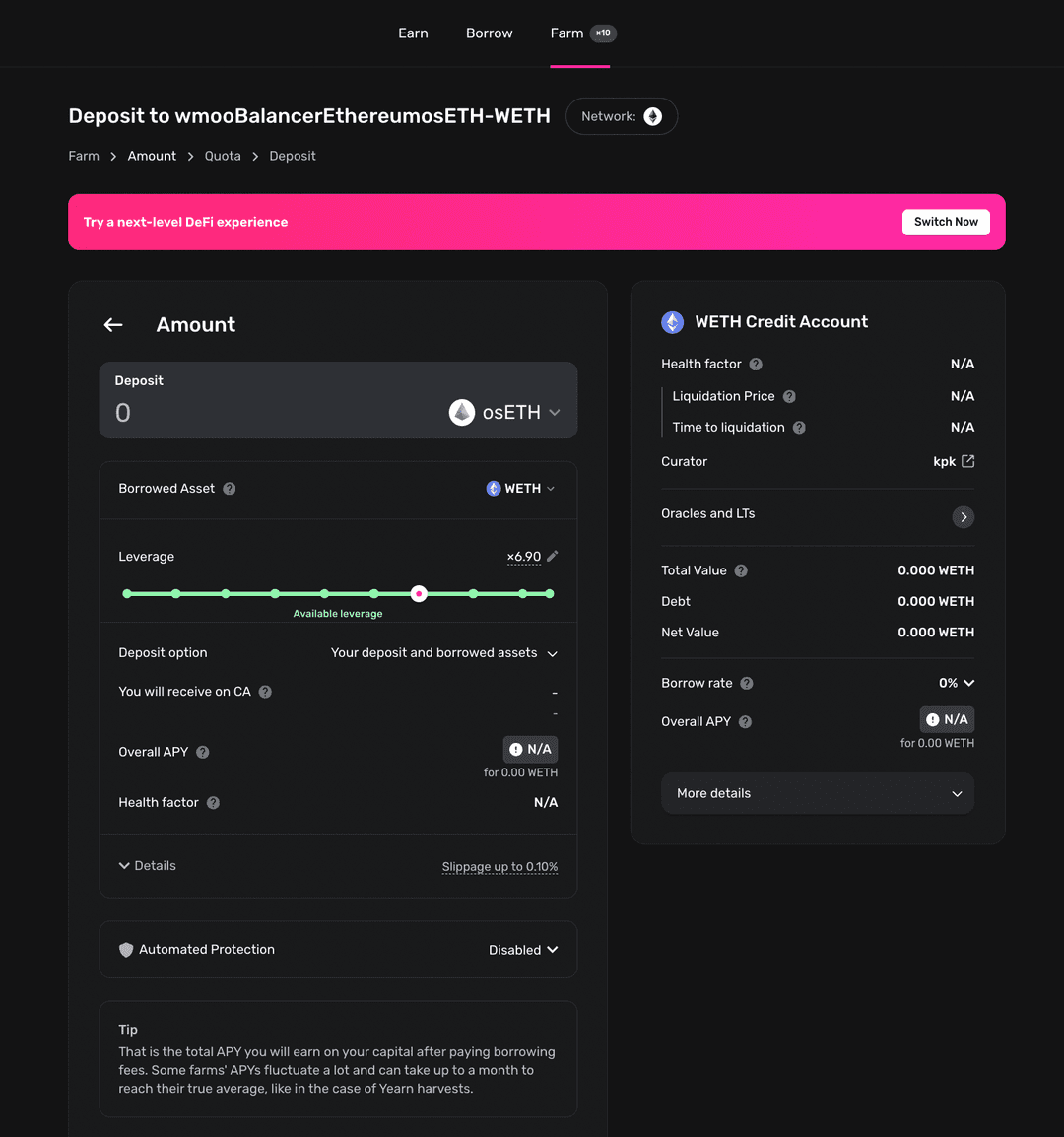
Navigate to the osETH/WETH Beefy strategy.
Enter deposit amount: How much osETH you want as initial collateral.
Select borrowed asset: Choose WETH or wstETH. You'll see kpk-curated “Boosted Beefy” Credit Managers with debt limits and available quota.
Set leverage: Use the slider to select your multiplier. The interface shows your projected Overall APY (after paying borrow fees), Health Factor (higher = safer), and Liquidation Price.
Choose deposit option: Select “Your deposit and borrowed assets” to convert everything into the yield-bearing position.
Review and confirm. Gearbox executes the entire looping strategy atomically.
Understanding Liquidations
Now that your position is live, it's important to understand how Gearbox protects lenders—and what happens if your position becomes undercollateralized.
Your position's solvency is measured by the Health Factor (HF)—the ratio of your risk-adjusted collateral value to your total debt. When HF drops below 1, your position becomes liquidatable. HF can decline if your collateral loses value (e.g. osETH depeg -> LP price drop), the borrowed asset appreciates (e.g. wstETH premium), or accrued negative interest erodes your margin over time (i.e. Beefy yield < debt interest rate).
Partial Liquidation: Before full liquidation, Gearbox offers protection via the Deleverage Bot. When HF drops below a safety threshold, the bot automatically sells a portion of your collateral to restore your Health Factor—charging a reduced premium. You can connect a bot directly through the Gearbox UI.
Full Liquidation: If HF drops sharply below 1, a liquidator repays your debt and claims your collateral at a discount. You lose your position minus debt repaid.
Protect yourself: Monitor your Health Factor in the interface. At 6x leverage, you have roughly an 8% osETH depeg buffer before liquidation risk materializes. You can always add collateral, repay debt, or exit entirely—no delays.
📘https://docs.gearbox.finance/about-gearbox/economics-and-risk/liquidation-dynamics
Risk Considerations
This strategy offers attractive yields but carries risks that require active awareness.
The primary concern is osETH depeg risk. Your collateral is priced based on the Balancer LP exchange rate—significant depegs of osETH from ETH will directly impact your Health Factor. A depeg greater than 2% starts affecting position safety. For this reason, it's recommended not to exceed 6x leverage, which provides a comfortable 8% depeg buffer before liquidation risk becomes material.
Yield compression is expected as more capital enters. The Balancer pool APY will decline with increased TVL—this strategy isn't as scalable as some alternatives. If your effective APY drops below the ETH or wstETH (whatever you borrowed) debt cost, the leveraged position may no longer make sense.
The upside: you can exit without delays. If conditions change, withdraw immediately through the Gearbox interface.